 CrunchAtlas
Network Detection and Response
Detect suspicious movement across IT and OT networks and investigate the activity behind it.
The firewall saw nothing. The network saw it.
What the edge sees Illustrative
A valid login from a trusted account
- Firewall: allowed
- VPN: valid user
- Inbound threats: none
- Alerts raised: none
Nothing crossed the edge, so nothing fired.
What the network shows Demonstration data
The same account moving from office IT into the plant
- Office laptop to engineering workstation
- Engineering workstation to HMI
- A path these systems have never used
- Ruled out: backups, patching
Attackers don't stay at the edge.
Why the edge misses it
One connection looks fine. The intrusion is in the sequence.
With AtlasCyber
Traffic between your systems, watched and investigated.
Passive Network Collection
It reads a copy of the traffic.
Nothing is injected, scanned, or installed on the process.
Your sources
A passive sensor, the tools you run, or capture files.
Your operator approves
Nothing changes in production without it.
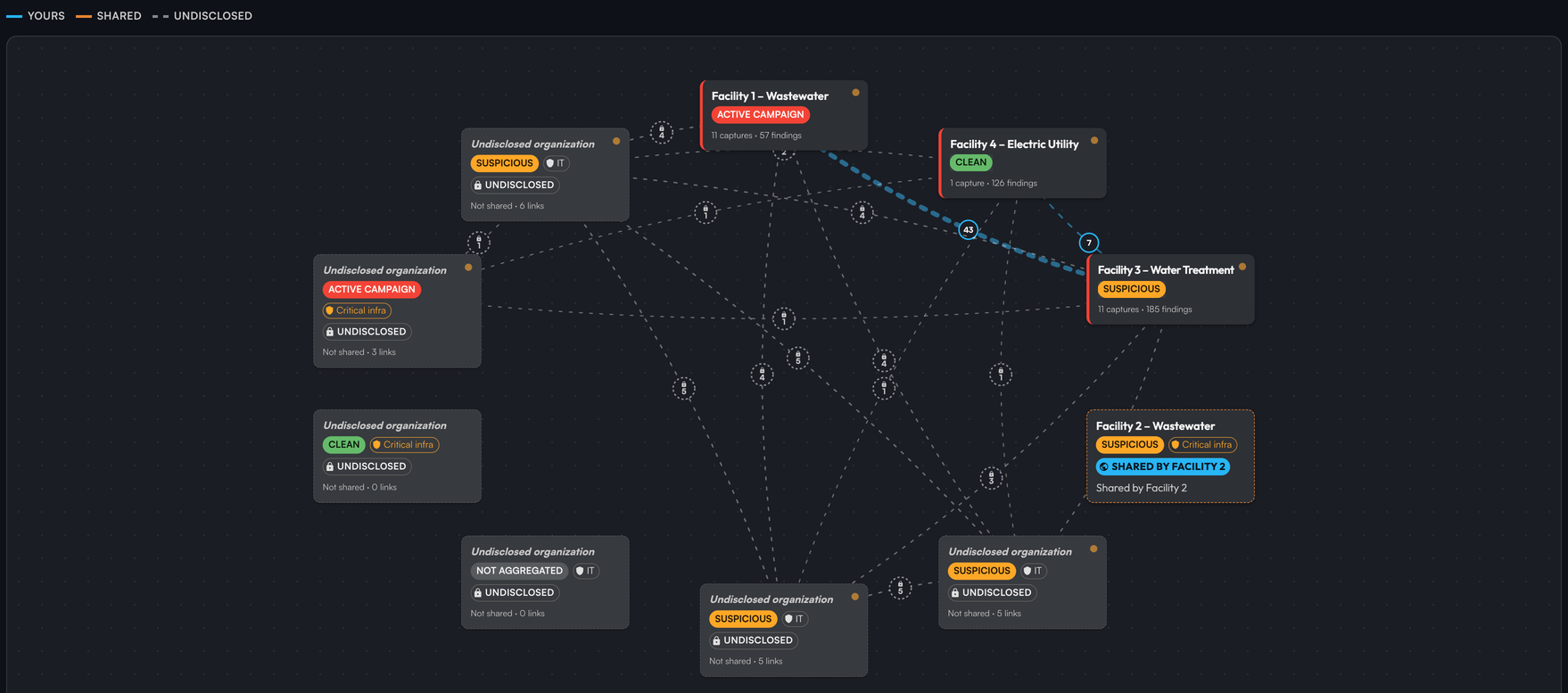
See communication paths and behavior across traffic available to AtlasCyber's network collection points.
See how it fits your network.
What it reads, where the sensor goes, and what comes back.
Where the case goes next.
Common questions.
Talk to an engineerWhat is the difference between NDR and EDR?
EDR watches activity on individual computers. NDR watches the traffic between systems, including devices like PLCs and HMIs that often can't run an endpoint agent.
What does NDR need to monitor a network?
A copy of traffic from a mirror port or network tap, the alerts your tools already raise, or capture files you have (PCAP, Zeek, NetFlow).
How does NDR detect lateral movement?
It learns which systems talk to each other and how. A new path, a new kind of command, or an odd sequence gets investigated, not just flagged.
See how AtlasCyber investigates activity inside your network.
What it watches across IT and OT, and how it turns movement into cases.
Talk to our teamSign up for our newsletter